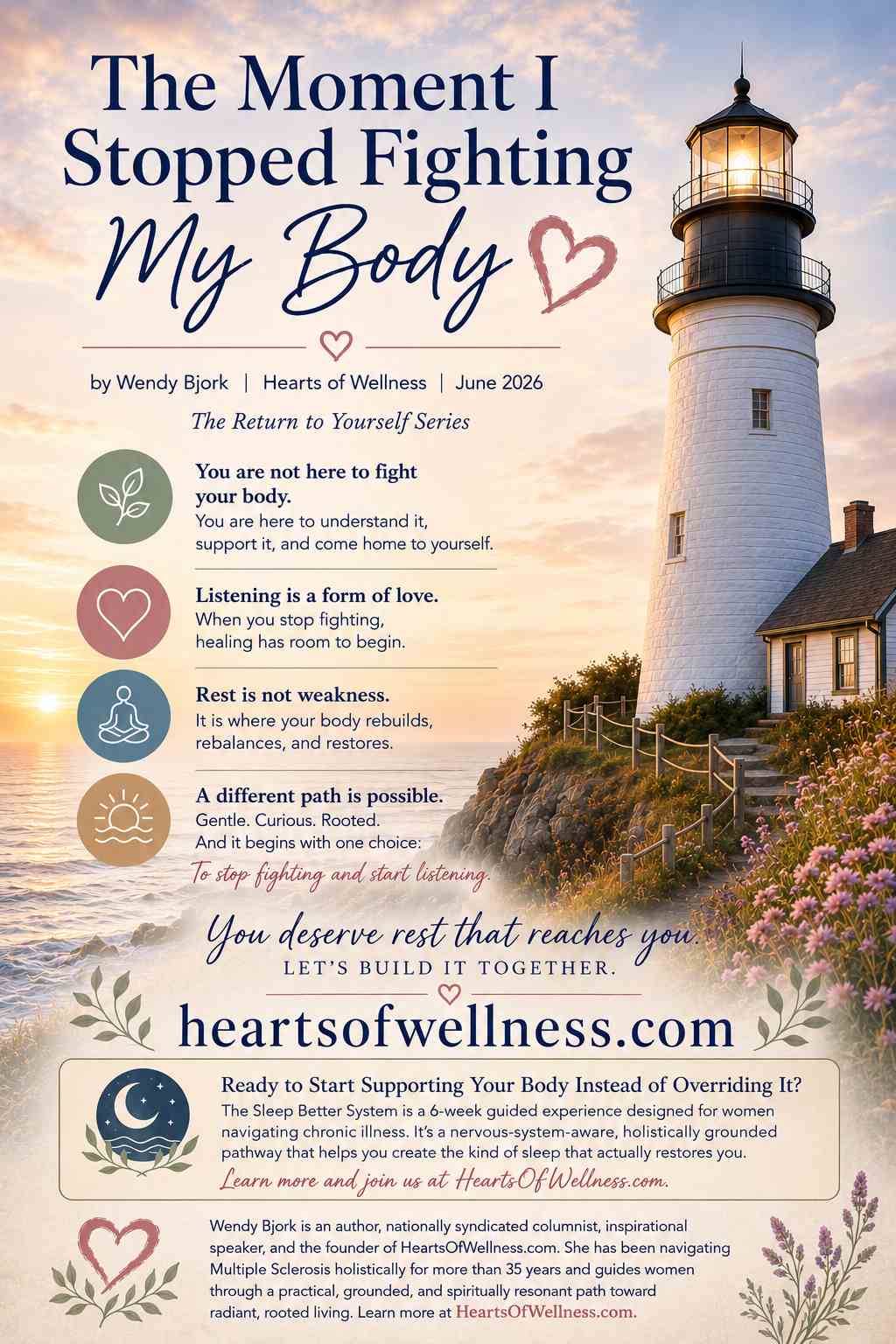

by Wendy Bjork | Hearts of Wellness | June 2026 The Return to Yourself Series, Article 1 of 4
There was a version of me who believed that if I just tried harder, pushed through more consistently, and refused to give in, I would somehow outrun Multiple Sclerosis.
I was not alone in that belief. It is practically the script we hand women when they receive a diagnosis like this. Show up stronger. Stay positive. Keep fighting.
For years, I did exactly that. And for years, I was exhausted in a way that sleep never quite touched.
What I did not understand then, and what took me a long time to say clearly, is that the fighting itself was part of what wore me down. Not the MS. The resistance to it. The constant internal battle between who I was determined to be and what my body was quietly, persistently asking me to hear.
The moment I stopped fighting was not dramatic. It did not happen on a particular Tuesday with a shaft of light coming through the window. It happened gradually, the way most real things do. A slow loosening. A small willingness to listen instead of overriding. A quiet question that began to surface more often than I expected.
What if my body is not my enemy?
The Language We Use Matters More Than We Realize
For a long time, the chronic illness community has leaned heavily on the language of battle. Fighting the disease. Defeating symptoms. Refusing to surrender. Staying strong no matter what.
I understand where that comes from. When you are terrified and in pain and the future feels uncertain, armor feels necessary. The identity of someone who fights can feel like the only thing standing between you and despair.
But here is what I have come to understand after more than 35 years of living with MS and walking alongside women who are navigating it every single day.
The nervous system does not know the difference between a threat in your environment and a threat you are generating inside your own mind.
When we stay in fighting mode, we stay in survival mode. And survival mode is expensive. It draws on resources the body desperately needs for healing, repair, and restoration. It keeps cortisol elevated. It disrupts sleep. It tightens muscles, constricts breath, and signals to every cell in the body that danger is present and the threat has not passed.
A nervous system living in a battle posture is a nervous system that never fully rests.
And a nervous system that never fully rests cannot do its most important work.
This is not a character flaw. It is not weakness. It is biology. Your body is doing exactly what it was designed to do when it perceives a sustained threat. The problem is that when the threat is framed as your own body, the battle never ends. There is nowhere to put down the armor. There is no victory condition. There is only more fighting.
That is a very hard way to live. And for many of the women I work with, it is the only way they have ever known how to exist inside this diagnosis.
What Listening Actually Looks Like
I want to be honest with you about something. Choosing to stop fighting your body does not mean giving up. It does not mean resignation or passivity or pretending that MS is not real and difficult and sometimes genuinely hard to navigate.
It means something more precise than that.
It means shifting from a posture of resistance into a posture of curiosity.
Instead of asking why is this happening to me and how do I make it stop, you begin to ask what is this telling me, and what does my body actually need right now?
That shift sounds small. In practice, it changes everything.
When I started asking different questions, I started noticing different things. I noticed that my symptoms often intensified during periods of sustained stress, not just because of the MS itself, but because of how I was responding to everything around me. The pace I was keeping. The things I was not saying. The rest I was skipping. The products in my home. The relationships I was spending energy in. The ways I was quietly, consistently overriding my own signals in favor of managing everyone else’s comfort.
My body had been speaking for a long time. I had simply been too busy fighting to hear it.
The Shift That Changed Everything
The turning point, when I look back honestly, was not finding the right supplement or the right specialist or the right protocol. It was the moment I became willing to be a student of my own experience rather than a soldier against it.
It was small things at first. Pausing before pushing through, sitting with a sensation instead of immediately trying to fix it or explain it away. Asking myself what I needed rather than what I was supposed to do next. Learning, slowly, to recognize the difference between my body asking for rest and my fear telling me that rest was dangerous.
That last one is subtle, but it is important. Many of us with chronic illness have a complicated relationship with slowing down. Somewhere along the way we learned that slowing down meant falling behind, or losing ground, or giving the illness more room. So we push, we override. We perform wellness while privately running on empty.
What I know now, and what I wish someone had told me much earlier, is that restoration is not the opposite of healing. Restoration is healing. The body does its deepest repair work not when we are pushing through, but when we feel safe enough to soften.
Safety is not passive, it is a skill. And it is one that can be learned, practiced, and gradually rebuilt, even when the nervous system has been in high alert for a very long time.
You Are Allowed to Choose a Different Path
If you have been living in fighting mode, I want you to know something.
The fact that you have kept going is not small. The strength it took to get here deserves to be honored. But strength does not always have to look like bracing. Sometimes the most powerful thing you can do is set down the armor long enough to ask what would actually help me right now.
Not what should help you or what worked for someone else. Not what the most recent article says you should be trying. What does your body, your nervous system, your quietest and most honest inner knowing say that you need?
That question is the beginning of a very different relationship with your health. It is also, I have found, the beginning of a life that feels more like yours.
Over the next several weeks, we are going to explore this together. We are going to look at why healing feels so hard when you are exhausted, why sleep matters more than most conversations acknowledge, and how small, gentle, consistent changes can shift the foundation of your daily experience in ways that nothing dramatic ever quite manages to do.
This is not a series about doing more, it is an invitation to come home to yourself.
And that journey, in my experience, always begins with the same first step.
Putting down the fight long enough to listen.
This Week’s Reflection
Where in your life are you still fighting yourself?
Not fighting the disease, not fighting circumstances, but fighting your own body’s signals, your own need for rest, your own quiet knowing that something needs to change?
You do not have to answer that question out loud. But I invite you to sit with it. Write it down if that helps. Let it surface without needing to fix it right away.
Sometimes the most important thing is simply being willing to hear the question.
Ready to Start Supporting Your Body Instead of Overriding It?
One of the most consistent things I hear from women navigating MS is that sleep feels broken. Either they cannot fall asleep, cannot stay asleep, or wake up feeling like they never truly rested at all.
This is not a coincidence. When the nervous system is chronically activated, the quality of sleep is one of the first things to suffer. And when sleep suffers, everything else becomes harder to manage.
That is exactly why I created the Sleep Better System, a six-week guided experience designed specifically for women navigating chronic illness who are ready to stop white-knuckling their way through exhausted days and start building a genuine foundation for rest and restoration.
This is not a generic sleep hygiene checklist. It is a nervous-system-aware, holistically grounded pathway that meets you where you are and helps you create the kind of sleep that actually restores you.
Learn more and join us at HeartsOfWellness.com.
You deserve rest that reaches you, let’s build it together.
Wendy Bjork is an author, nationally syndicated columnist, inspirational speaker, and the founder of HeartsOfWellness.com. She has been navigating Multiple Sclerosis for more than 35 years and guides women through a practical, grounded, and spiritually resonant path toward radiant, rooted living. Learn more at HeartsOfWellness.com.
This article is part of The Return to Yourself, a four-part June 2026 series exploring nervous system healing, rest, and coming home to who you are beneath the diagnosis.
Follow Wendy HeartsOfWellness.com/Social
Twitter/X: @bjork_ms
FB page: Wendy Bjork Hearts of Wellness
YouTube Channel: www.youtube.com/@wendybjork
LinkedIn: https://www.linkedin.com/in/wendybjork
Instagram: @theempressofms
Pinterest: pinterest.com/EmpressofMS
Check out more lifestyle stories here.
Explore more insights at https://usadailypost.com/.