
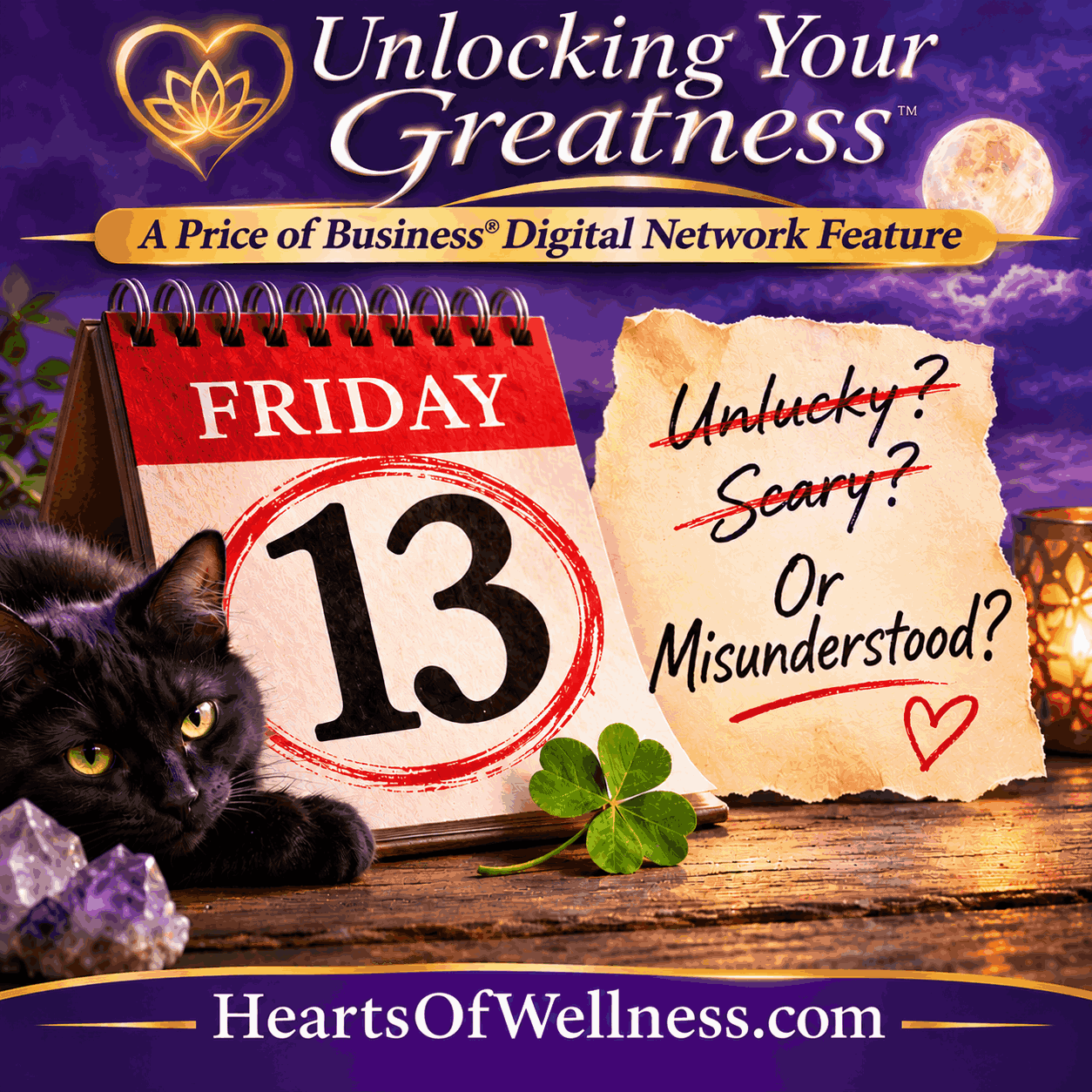

Friday the 13th: What If Everything We’ve Been Told About This Day Is Wrong?
By Wendy Bjork | Unlocking Your Greatness | HeartsOfWellness.com
Friday the 13th is coming.
For some people, those four words inspire anxiety. Maybe they avoid important decisions, postpone travel plans, or quietly hope the day passes without anything unusual happening.
Others laugh at the superstition while still knocking on wood, just in case.
But have you ever wondered why we’re supposed to fear this particular day?
After all, it’s another square on the calendar. The sun rises, the world keeps turning, and somewhere, someone is celebrating a birthday, receiving wonderful news, or experiencing something life-changing.
So how did Friday the 13th earn such a terrible reputation?
And what does this superstition reveal about the beliefs we carry into other areas of life, including our health and well-being?
How Did 13 Become Unlucky?
The fear surrounding Friday the 13th has been passed through generations, influenced by religious traditions, mythology, folklore, and popular culture.
In Western traditions, the number 12 has long represented completeness. We have 12 months, 12 zodiac signs, and 12 hours on a traditional clock.
Then comes 13. One step beyond the familiar.
Historically, the number became associated with misfortune through several traditions, including interpretations of the Last Supper, where 13 people gathered before the crucifixion of Jesus.
Over time, separate superstitions surrounding Fridays and the number 13 became intertwined.
Interestingly, not every culture considers Friday the 13th unlucky. In Spain and some other countries, Tuesday the 13th carries that reputation. In Italy, the number 17 has traditionally been considered unlucky.
Apparently, even bad luck has trouble agreeing on a schedule.
If a particular day were inherently unlucky, wouldn’t that be true everywhere?
Perhaps what we’re experiencing has less to do with the calendar and more to do with the stories we’ve inherited.
The Other Side of 13
While some traditions associate 13 with misfortune, others connect it with transformation, renewal, and nature’s rhythms.
Consider the moon. A solar year contains approximately 12.37 lunar cycles, meaning some calendar years have 13 full moons.
Throughout history, lunar cycles have influenced agriculture, seasonal celebrations, and spiritual traditions.
In some modern spiritual interpretations, 13 symbolizes feminine wisdom, intuition, and life’s natural cycles.
Pythagoras’ Numerology offers another perspective. Adding 1 + 3 equals 4, a number traditionally associated with stability, structure, and building strong foundations.
These symbolic interpretations aren’t scientific predictions, but they invite us to reconsider something we’ve been conditioned to fear.
What if 13 represented the courage to move beyond the familiar?
What if transformation begins when we question an old belief?
The Invisible Stress of What We’re Taught to Believe
This conversation becomes especially meaningful for those navigating chronic health conditions.
Society has plenty of unwritten rules about what a healthy, successful, productive life should look like.
We’re taught that working harder produces better results. That staying busy demonstrates our value. That rest must be earned. That asking for help somehow diminishes our independence.
We’re also surrounded by messages suggesting that the right attitude, perfect routine, or latest wellness trend should make our bodies respond exactly as expected.
But human bodies aren’t machines, and chronic illness rarely follows a predictable schedule.
Living with multiple sclerosis has taught me that some of the most exhausting challenges aren’t always physical.
Sometimes it’s the pressure to explain why we’re tired, justify changing plans, or prove we’re doing everything possible to improve our health.
There’s the expectation to look well even when we feel otherwise.
The pressure to keep up with people whose bodies operate differently.
And the endless stream of well-intentioned suggestions about what we should eat, try, purchase, eliminate, or change.
Each expectation can become another layer of stress added to an already complicated day.
Much like Friday the 13th, these beliefs become so familiar that we rarely question whether they’re true.
Rest isn’t laziness. A difficult symptom day isn’t a personal failure. And adjusting our plans doesn’t mean we’ve lost our ability to create a meaningful life.
Wellness deserves a more compassionate and realistic definition.
What We Expect: Influences We Notice
Our minds are remarkably skilled at finding evidence supporting what we already believe. Psychologists call this confirmation bias.
Wake up on Friday the 13th expecting misfortune, and every inconvenience might seem significant.
Spill your coffee? Of course. It’s Friday the 13th.
Get stuck in traffic? There it is again.
Misplace your keys? Clearly, the universe has an agenda.
Yet those same experiences on an ordinary Tuesday might barely register.
Now consider how this pattern can influence chronic illness.
When we’re repeatedly told to expect decline, limitations, or a future defined entirely by a diagnosis, those predictions can begin shaping how we see ourselves.
We may hesitate to pursue something meaningful, even when it could be adapted to our abilities.
We might interpret every setback as evidence that life is becoming smaller.
Of course, symptoms and medical realities deserve appropriate attention. Positive thinking doesn’t erase neurological conditions, fatigue, or physical limitations.
But there’s an important difference between respecting what our bodies communicate and allowing fear-based expectations to make every decision.
Our beliefs don’t determine every outcome, but they can influence our choices, stress levels, and willingness to explore possibilities.
When Someone Else’s Prediction Becomes Our Story
I began experiencing symptoms of multiple sclerosis as a teenager, long before I understood what was happening inside my body.
Over the years, I’ve heard predictions about what my future might look like.
Some reflected medical knowledge. Others reflected uncertainty or the limitations of what was understood at the time.
I’ve learned that receiving information and surrendering my identity to someone else’s expectations are two very different things.
Living with a chronic condition requires awareness, adaptation, and sometimes difficult decisions.
But we can respect medical guidance while remembering that an individual future cannot always be predicted with certainty.
We can acknowledge challenges without making them our entire story.
Chronic illness already asks so much of us. Managing appointments, changing symptoms, financial concerns, relationships, and everyday responsibilities creates a substantial mental and emotional load.
Adding unnecessary expectations only increases that burden. Sometimes a meaningful shift begins with one question:
Is this belief supporting my well-being, or am I carrying it simply because someone taught me to?
Reclaiming Friday the 13th
This November 13, consider turning the day into a personal experiment.
Identify one belief you’ve carried simply because someone told you it was true.
Maybe it’s the idea that slowing down means falling behind.
Perhaps you’ve believed that asking for help makes you less independent.
Or maybe you’ve absorbed the message that a chronic condition automatically determines the size of your future.
Ask yourself where that belief originated and whether it reflects your present reality.
Then choose one small action representing a new perspective.
Allow yourself to rest without negotiating whether you’ve earned it.
Set a boundary around advice that leaves you overwhelmed.
Celebrate something meaningful your body helped you experience today.
Or explore an opportunity that interests you, with whatever support makes sense.
These choices may not change every circumstance, but they can change how we relate to our circumstances.
And that’s where personal empowerment begins.
The Real Power Behind the Date
There’s no reliable scientific evidence that Friday the 13th brings more misfortune than other days.
Yet the superstition continues because stories have power, especially those repeated across generations.
The same is true of expectations surrounding health, aging, productivity, and what constitutes a fulfilling life.
Some beliefs help us make informed decisions. Others quietly convince us that our possibilities are smaller than they actually are.
Friday, November 13, 2026, will arrive regardless of what we believe about it.
Will we spend the day expecting something to go wrong?
Or recognize another opportunity to live with curiosity, awareness, and intention?
Perhaps the number 13 was never the problem.
Perhaps the real limitation was believing something outside ourselves could determine our possibilities.
Your greatness isn’t measured by how perfectly your body performs, how much you accomplish, or whether life unfolds according to someone else’s expectations. It grows when you honor your reality, question unnecessary limitations, and make room for what brings meaning and joy.
And if Friday the 13th brings you something wonderful?
Well, you can always blame the calendar.
Wendy Bjork is an international bestselling co-author, nationally syndicated columnist, inspirational speaker, and founder of Hearts of Wellness. Drawing from more than 35 years of lived experience with chronic illness, she helps people strengthen self-trust, reconnect with their inner wisdom, and navigate life’s changing seasons through holistic wellness and personal empowerment.
Explore her work and personalized Soul Shift experiences at HeartsOfWellness.com.
Follow Wendy HeartsOfWellness.com/Social
Connect with her through social media:
Twitter/X: @bjork_ms
Facebook page: Wendy Bjork Hearts of Wellness
YouTube Channel: www.youtube.com/@wendybjork
LinkedIn: https://www.linkedin.com/in/wendybjork
Instagram: @theempressofms
Pinterest: pinterest.com/EmpressofMS
For more great lifestyle content, see here.
Explore more insights at https://usadailypost.com/.



1 thought on “Friday the 13th: Unlucky, Scary, or Simply Misunderstood?”